PM Nawaz announces national mourning on Thursday over university attack

Nawaz_Sharif1


ISLAMABAD (Staff Reporter) – Prime Minister Nawaz Sharif on Wednesday announced to observe a day of national mourning across the country on Thursday following the deadly terrorist attack on the Bacha Khan University in Charsadda.

Prime Minister Sharif, who is in Davos to attend the World Economic Forum (WEF), also telephoned Army Chief General Raheel Sharif and appreciated the swift military action after the terrorist assault.

Meanwhile, the Khyber Pakhunkhwa government also announced 3-day of mourning across the province.

At least 30 people mostly students embraced martyrdom and scores of others were wounded when four heavily-armed gunmen stormed Bacha Khan University on Wednesday morning.

Oil dives to fresh 12-year low under $28

oil


LONDON (APP) – Oil plunged to fresh 12-year lows under $28 on Wednesday, slammed by gloomy economic forecasts, China’s slowdown and abundant crude supplies.

In morning deals, US benchmark West Texas Intermediate (WTI) for February delivery tanked to $27.32 per barrel, a level last seen on September 24, 2003.

The contract later stood at $27.80, down 66 cents from Tuesday’s closing level.

The global oil market has collapsed further since the International Energy Agency warned Tuesday that the oil market could “drown in oversupply”. Prices have crashed about 75 percent since mid-2014, hit by a perfect storm of a stubborn supply glut, the slowing global economy and the rebounding US dollar.

“A stronger dollar continues to present significant headwinds and supply increases show little sign of letting up any time soon,” Sucden analyst Kash Kamal told AFP. “This is very much a supply issue, as global demand has on the whole been quite healthy — but it is likely we will see additional price declines and tighter margins before producers are prompted to cut output.”

The strong dollar meanwhile makes dollar-priced crude more expensive for buyers using weaker currencies. In turn, that dents demand and prices.

Approaching midday in London, Brent North Sea crude for delivery in March slid 67 cents to $28.09 compared with the close on Tuesday.

Brent had tumbled on Tuesday to $27.67, a low last witnessed on November 25, 2003.

Crude futures are also in freefall with the supply glut set to worsen, as Iran pumps out extra barrels after the lifting of Western sanctions on Tehran.

The IEA predicted Tuesday that prices would fall further this year as supply vastly exceeds demand, with major oil exporter Iran’s return to the market offsetting any production cuts from other countries.

Match-fixing and tech: Betting apps fueling corruption in sports

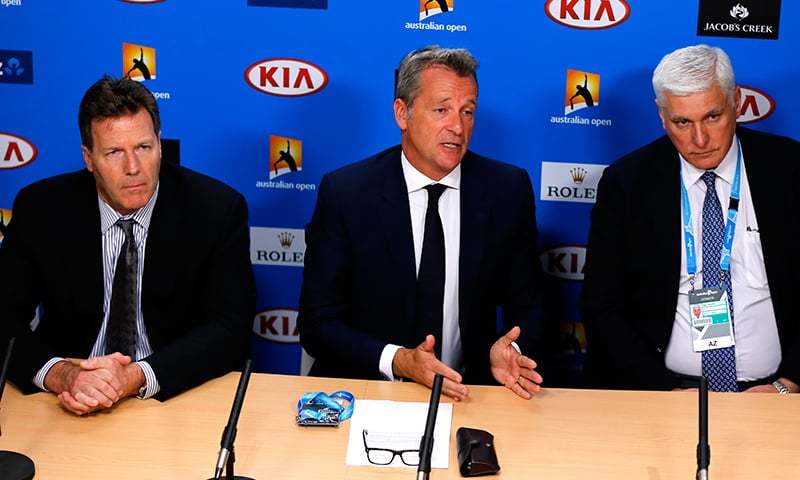
ATP Chairman Kermode and the Tennis Integrity United have rejected news reports that match-fixing has gone unchecked in the sport. — AP/File


SYDNEY: The rise of mobile betting is transforming global sports wagering faster than regulators can react, flooding the industry with cash and potentially contributing to corruption scandals like the one roiling world tennis, experts and insiders say.

Allegations this week that tennis authorities failed to deal with widespread match-fixing has rocked the game, following similar allegations that have blighted cricket, football and other sports.

The ubiquity of mobile phones and tablets has helped transformed bookmakers from operators of dingy, smoke-filled betting shops into multi-billion dollar de facto tech firms, pouring resources into developing apps and complex algorithms and marketing to younger and broader demographics.

“We’re no longer restricted by geography or the limited choices of one betting company. And we have wall-to-wall sport every day of the week from across the globe beamed into our lounge rooms, on our smartphones,” said Scott Ferguson, a wagering industry consultant.

“Technology is everything.”

The greatest danger for mobile gambling to intersect with corruption lies in the ease of fixing a one-on-one sport like tennis, darts or snooker, according to experts and professional gamblers.

Mobile apps that allow in-game betting on individual points or games allow athletes to stealthily manipulate the results and may strike some of them as less unethical as throwing an entire match, said Sally Gainsbury, a senior lecturer at Southern Cross University who has written a book on the subject.

“A Perfect Combination”

Most major bookmakers operate from small offshore jurisdictions, making accurate predictions of industry worth extremely difficult, said Gainsbury.

“There’s a large grey sort of offshore market … in every country, where it’s actually just not possible for the government to regulate these sites that are based in all these tiny remote jurisdictions,” she told Reuters.

“So it’s difficult to get a really accurate size of how much people are betting because a lot of it is actually illegal.”

Patrick Jay, a betting consultant and former head of trading at Betfair, estimates the global sports betting market is likely worth about $1 trillion a year, having doubled in size in the last five years. He expects it to double again in the next five.

The Australian government, citing a 2015 United Nations conference at which Jay was a speaker, put that figure as high as $3 trillion, of which 90 percent was “illegal” or in contravention of laws regulating gambling in which the bet was placed.

That range of figures, which includes betting on sports from soccer, cricket and tennis to much less widely followed sports like snooker, darts and table tennis but excludes racing, illustrates the difficulty in accurately valuing the overall market.

“It has grown because of mobile technology. It allows people to place bets anywhere, anytime,” Jay told Reuters. “People are also dealing in credit, and therefore accounts are being run all over the world. It has created a perfect combination.”

Leading bookmakers including Betfair Group PLC, Ladbrokes PLC, Paddy Power PLC and William Hill PLC did not respond to requests for comment. There have not been any allegations of wrongdoing by the bookmakers in the World Tennis scandal.

Worried about the boom in sports betting and incidents of match fixing, countries like Australia and across the European Union are in the process of reviewing laws that experts like Gainsbury say are “hopelessly outdated”.

In Australia, for example, 2001 laws regulating Internet sport betting bar anyone from placing a bet on a sporting event online once it has begun, despite allowing live betting over the phone or at retail bookmakers.

William Hill, an official partner of the Australian Open, has a new “Bet-in-Play” feature for its Australian customers that requires access to a smartphone’s microphone while the bet is placed to comply with such laws.

“There’s been a lot of stagnation where a lot of countries originally said, ‘Well this is illegal, we won’t let them do this’, but of course with the internet you can’t make things illegal and stop people going online,” Gainsbury said.

9 wickets for 46 runs: Stunning collapse results in yet another India defeat

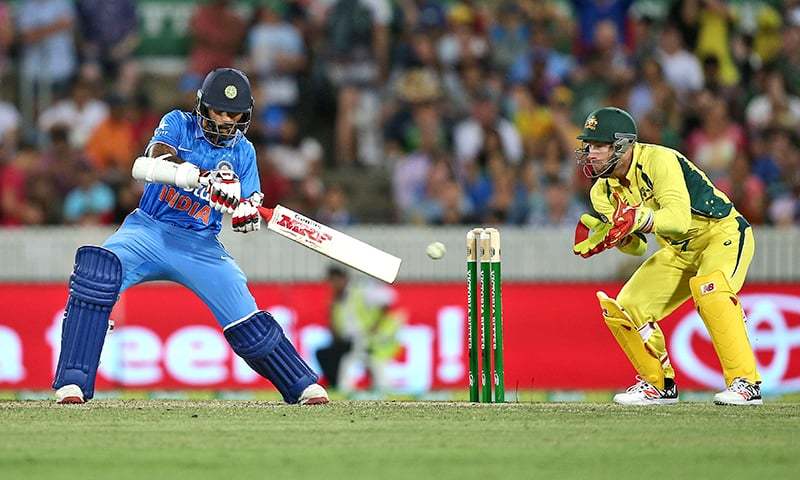
Shikhar Dhawan plays a shot against Australia. — AP


CANBERRA: A spectacular Indian batting collapse gave Australia a 25-run victory in the one-day international in Canberra on Wednesday, their fourth successive victory in the five-match series.

After winning the toss and choosing to bat, Australian openers Aaron Finch and David Warner both posted big scores to take the home side to a massive 348 for eight.

The Indians looked well on target when Shikhar Dhawan (126) and Virat Kohli (106) put on 212 for the second wicket to reach 277 for one, smashing the attack all over Manuka Oval.

Neither batsman was in any trouble on a lifeless pitch and none of the Australian bowlers were spared.

But once Dhawan fell cutting John Hastings to George Bailey at point, the Indian wickets began falling regularly and the Australians began to assert control.

Skipper Mahendra Singh Dhoni fell for a duck before Kohli hit a catch to Australian captain Steve Smith at mid-off, his only false shot in a magnificent 92-ball innings.

With four wickets down and in-form batsman Ajinkya Rahane hampered by split webbing on his hand, the Indians began to panic as they lost Gurkeerat Singh (5), Rahane (2) and Rishi Dhawan (9) in quick succession.

The tailenders put up little resistance and Australia took the last nine wickets for just 46 runs to wrap up an unlikely victory.

“It’s a funny game isn’t it?” said a delighted Smith.

“It looked like they were cruising for a while there, but a couple of wickets always changes the swing of things.

“We had a never say die attitude tonight, which is something I want to instil in these guys.

“We worked incredibly hard to get back into that game and when we got a sniff we ran with it.”

Dhoni said he took responsibility for the loss after failing to capitalise on the good start to the run chase.

“That’s what my job in the team is, to finish off the games from that type of position, but unfortunately I got out,” he said.

“There was a bit of pressure on the youngsters but I think certainly we should have done much better.

“The way we started was what we needed and the partnership between Shikhar and Virat was magnificent.”

Earlier Finch made 107 and Warner 93 in a huge opening stand of 187. Smith then smashed 51 off only 29 balls and Glenn Maxwell 41 from 20 in a display of powerful shotmaking.

Warner brought up his 50 from 46 balls with eight fours and one six.

Finch was more sedate than his partner, taking 61 balls for his half century, but began to pick up the pace soon afterwards.

His innings was especially damaging to umpire Richard Kettleborough, who was hit on the shin by a powerful on-drive and had to be replaced in the middle by Paul Wilson.

After breaking the opening stand India took regular wickets to slow the scoring down until Maxwell let rip in the last two overs to post a target that eventually proved too much.

World Book Day: Kids invited to join for literature quiz record attempt

Guinness World Records has partnered up with World Book Day to put a record-breaking spin on the annual celebration of reading.
The 19th World Book Day takes place on 3 March 2016 and invites children of all ages to come together to explore and enjoy books.
In the run up to the main event, organisers are encouraging kids to take part in ‘The Bumper Book Quiz’ and join an official record attempt for the Most people participating in simultaneous literature quizzes (multiple venues).
On 22 February from 2-3 pm, groups of children aged between 5 and 14 will be quizzed on their knowledge of contemporary and classic kids’ books, with the chance to become an official record breaker.
In order to set this all-new record, a minimum of 2,679 people must take part and each quiz is required to last a minimum of 30 minutes.

world-book-day-2016-quiz-logo

Kirsten Grant, Director of World Book Day, said: “This is the first time that World Book Day has made a Guinness World Record attempt and we’re hoping that the industry is going to come out in support by putting on events in offices and bookshops across the UK … we thought what better way to bring book lovers together than with this fun, co-ordinated quiz-along.”

World’s oldest man Yasutaro Koide passes away aged 112


Guinness World Records is saddened to confirm that Yasutaro Koide, the world’s oldest man living has passed away in a hospital in Nagoya, Japan at the incredible age of 112. 


A former tailor for a men’s clothes shop, Yasutaro was born on 13 March 1903 – the year that the Wright Brothers created the first ever successful airplane, and the year the debut Tour de France cycling race took place.

oldest-person-living-male-header


On hearing the news of this iconic record holder’s death, VP Guinness World Records Japan Erika Ogawa said: ”I felt very honoured that I have had a chance to meet Mr. Yasutaro Koide last summer, surrounded by his warm family and relatives. The stories of his adolescent years encouraged all of us who were there. I would like to express my sorrow and condolences to him and his family.”


Erika visited the oldest man on 20 August 2015 to present him with a certificate of his record title and celebrate his amazing long life.

Yasutaro Koide slider

At this time, Yasutaro was doing very well for his age, living at home and regularly attending a day care centre. Impressively, he was still able to walk when at home, but otherwise he used a wheelchair. He used his own teeth rather than dentures to eat and could read the newspaper without glasses.
“The best thing is to not overdo,” Yasutaro told the Associated Press at the time of the presentation.
His granddaughter, Aya Kikuchi, told local newspaper Chunichi Shimbun that her grandfather used to be very strict about manners: “He was very stubborn, but he got nicer with age,” she said. “His lifestyle is one that avoids stress.”
Yasutaro Koide as a young man
Mr Koide was just four years behind the Oldest man ever, Jiroemon Kimura (also Japan), who lived until he was 116 years old and 54 days.

Glenn Frey 1948 – 2016: Founder and guitarist of the record-breaking band Eagles passes away

Glenn Frey, a founding member of Eagles, one of the most successful bands of all time, has passed away in New York at the age of 67.
The singer and writer of some the bands biggest hits, had been suffering from intestinal problems for several months.
A statement confirming the news was posted on the band’s Facebook page last night that read: “Words can neither describe our sorrow, nor our love and respect for all that he has given to us, his family, the music community and millions of fans worldwide.”
The band hold the Guinness World Records title for Best-selling album in the USA by a group.
Their Greatest Hits (1971–1975)(Elektra, 1976) has been certified 29x Platinum by the RIAA (Recording Industry Association of America), meaning it has shipped more than 29 million units.
Frey co-founded the band with drummer and fellow vocalist Don Henley in LA in the early 1970s along with guitarist Bernie Leadon and bassist Randy Meisner.
The band’s blending of country and rock soon saw them become one of the great forces of popular music during that decade alongside the likes of Led Zeppelin and Fleetwood Mac, with hits such as “Hotel California” and “Life in the Fast Lane”.
In the US, they scored five number one singles and four number one albums, notching up more than 150 million album sales worldwide, with Frey acting as one the group’s main songwriters.
Despite their incredible success, the band broke up in 1980 in acrimonious circumstances.
Following the group’s split, Frey enjoyed success as a solo artist, with his track The Heat is On, recorded for the 1984 film Beverly Hills Cop, reaching number two on the Billboard Hot 100 chart in March 1985.
Henley had infamously vowed the Eagles would reunite only when “hell freezes over”, a line which would become the title of the 1994 album when they eventually re-formed.
Paying tribute to his fellow band member, Henley praised Frey’s work ethic and “encyclopaedic” knowledge of music.
“He was like a brother to me; we were family, and like most families, there was some dysfunction.
“Glenn was the one who started it all. He was the spark plug, the man with the plan”
He had an encyclopaedic knowledge of popular music and a work ethic that wouldn’t quit. He was funny, bullheaded, mercurial, generous, deeply talented and driven.”
Guinness World Records would like to extend our condolences to Glenn’s family and friends, as well as his many fans around the world.

LIVE: 21 killed, over 30 injured as gunmen attack Bacha Khan University in Charsadda

CHARSADDA: A group of militants stormed Bacha Khan University in Charsadda on Wednesday morning. Firing and blasts were heard from inside the campus as the army carried out a clearance operation.

The militants, using the cover of thick, wintry fog, scaled the walls of the Bacha Khan University before entering buildings and opening fire on students and teachers in classrooms and hostels, police said.

The gunmen attacked as the university prepared to host a poetry recital on Wednesday afternoon to commemorate the death anniversary of Khan Abdul Ghaffar Khan, a popular ethnic Pashtun independence activist after whom the university is named.

The attack comes a little over a year after Taliban gunmen stormed Army Public School in December 2014 and slaughtered more than 150 people, most of them children, in an hours-long siege.

What we know so far:

– Gunfire, blasts heard as army carries out operation

21 killed, over 30 injured so far. Casualties feared to rise dramatically

– Four militants killed so far

– TTP claims responsibility for attack

– Army clearance operation underway 

Army chief arrives at Bacha Khan University

Army chief General Raheel Sharif arrives in Charsadda in wake of the attack at Bacha Khan University, Express News reports.


At least 14 martyred as terrorists attack Bacha Khan University in Charsadda


CHARSADDA: Militants stormed the Bacha Khan University in Charsadda on Wednesday, martyring at least 14 people and wounding at least 50 as the army hunted for any gunmen still holed up on the campus, officials said.

Security officials said the death toll could rise to as army commandos cleared out student hostels and classrooms.

Government officials gave contradicting figures for the death toll, with Khyber Pakhtunkhwa provincial legislator Shaukat Yousafzai saying as many as 25 people had been killed by the attackers.

But, KP information minister Shah Farman said that 14 people had been confirmed to have been killed.

Those confirmed to have been martyred included four security guards, a policeman, a chemistry professor, and two students.

The army said four terrorists were also killed by security personnel as they scoured the campus for any remaining attackers.

The Bacha Khan University is a public university approximately 15 kilometers from the centre of Charsadda city. It is named after the peace activist and leader Bacha Khan whose message of peace remains the motto of the university.

The attack comes on the same date as his death anniversary when a poetic symposium has been organized on campus. University officials said around 600 guests were also at the university when the attackers entered the campus and opened fire.

Computer Engineering

Computer engineering is a discipline that integrates several fields of electrical engineering and computer science required to develop computer hardware and software. Computer engineers usually have training in electronic engineering (or electrical engineering), software design, and hardware-software integration instead of only software engineering or electronic engineering. Computer engineers are involved in many hardware and software aspects of computing, from the design of individual microcontrollers, microprocessors, personal computers, and supercomputers, to circuit design. This field of engineering not only focuses on how computer systems themselves work, but also how they integrate into the larger picture.

Usual tasks involving computer engineers include writing software and firmware for embedded microcontrollers, designing VLSI chips, designing analog sensors, designing mixed signal circuit boards, and designing operating systems. Computer engineers are also suited for robotics research, which relies heavily on using digital systems to control and monitor electrical systems like motors, communications, and sensors.

In many institutions, computer engineering students are allowed to choose areas of in-depth study in their junior and senior year, because the full breadth of knowledge used in the design and application of computers is beyond the scope of an undergraduate degree. Other institutions may require engineering students to complete one year of General Engineering before declaring computer engineering as their primary focus.

History

The first computer engineering degree program in the United States was established at Case Western Reserve University in 1972. As of 2015, there were 238 ABET-accredited computer engineering programs in the US. In Europe, accreditation of computer engineering schools is done by a variety of agencies part of the EQANIE network. Due to increasing job requirements for engineers who can concurrently design hardware, software, firmware, and manage all forms of computer systems used in industry, some tertiary institutions around the world offer a bachelor’s degree generally called computer engineering. Both computer engineering and electronic engineering programs include analog and digital circuit design in their curriculum. As with most engineering disciplines, having a sound knowledge of mathematics and science is necessary for computer engineers

Work

There are two major specialties in computer engineering: software and hardware

Computer software engineering

Computer software engineers develop, design, and test software. Some software engineers design, construct, and maintain computer programs for companies. Some set up networks such as “intranets” for companies. Others make or install new software or upgrade computer systems. Computer software engineers can also work in application design. This involves designing or coding new programs and applications to meet the needs of a business or individual. Computer software engineers can also work as freelancers and sell their software products/applications to an enterprise/individual.

Computer hardware engineering

Most computer hardware engineers research, develop, design, and test various computer equipment. This can range from circuit boards and microprocessors to routers. Some update existing computer equipment to be more efficient and work with newer software. Most computer hardware engineers work in research laboratories and high-tech manufacturing firms. Some also work for the federal government. According to BLS, 95% of computer hardware engineers work in metropolitan areas. They generally work full-time. Approximately 33% of their work requires more than 40 hours a week. The median salary for employed qualified computer hardware engineers (2012) was $100,920 per year or $48.52 per hour. Computer hardware engineers held 83,300 jobs in 2012.

Specialty areas

There are many specialty areas in the field of computer engineering.

Coding, cryptography, and information protection

Main article: Information security

Computer engineers work in coding, cryptography, and information protection to develop new methods for protecting various information, such as digital images and music, fragmentation, copyright infringement and other forms of tampering. Examples include work on wireless communications, multi-antenna systems, optical transmission, and digital watermarking.

Communications and wireless networks

Main articles: Communications networks and Wireless network

Those focusing on communications and wireless networks, work advancements in telecommunications systems and networks (especially wireless networks), modulation and error-control coding, and information theory. High-speed network design, interference suppression and modulation, design and analysis of fault-tolerant system, and storage and transmission schemes are all a part of this specialty.

Compilers and operating systems

Main articles: Compiler and Operating system

This specialty focuses on compilers and operating systems design and development. Engineers in this field develop new operating system architecture, program analysis techniques, and new techniques to assure quality. Examples of work in this field includes post-link-time code transformation algorithm development and new operating system development.

Computational science and engineering

Main article: Computational science and engineering

Computational Science and Engineering is a relatively new discipline. According to the Sloan Career Cornerstone Center, individuals working in this area, “computational methods are applied to formulate and solve complex mathematical problems in engineering and the physical and the social sciences. Examples include aircraft design, the plasma processing of nanometer features on semiconductor wafers, VLSI circuit design, radar detection systems, ion transport through biological channels, and much more”.

Computer networks, mobile computing, and distributed systems

Main articles: Computer network, Mobile computing and Distributed computing

In this specialty, engineers build integrated environments for computing, communications, and information access. Examples include shared-channel wireless networks, adaptive resource management in various systems, and improving the quality of service in mobile and ATM environments. Some other examples include work on wireless network systems and fast Ethernet cluster wired systems.

Computer systems: architecture, parallel processing, and dependability

Main articles: Computer architecture, Parallel computing and Dependability

Engineers working in computer systems work on research projects that allow for reliable, secure, and high-performance computer systems. Projects such as designing processors for multi-threading and parallel processing are included in this field. Other examples of work in this field include development of new theories, algorithms, and other tools that add performance to computer systems.

Computer vision and robotics

Main articles: Computer vision and Robotics

In this specialty, computer engineers focus on developing visual sensing technology to sense an environment, representation of an environment, and manipulation of the environment. The gathered three-dimensional information is then implemented to perform a variety of tasks. These include, improved human modeling, image communication, and human-computer interfaces, as well as devices such as special-purpose cameras with versatile vision sensors.

Embedded systems

Examples of devices that use embedded systems.
Main article: Embedded systems

Individuals working in this area design technology for enhancing the speed, reliability, and performance of systems. Embedded systems are found in many devices from a small FM radio to the space shuttle. According to the Sloan Cornerstone Career Center, ongoing developments in embedded systems include “automated vehicles and equipment to conduct search and rescue, automated transportation systems, and human-robot coordination to repair equipment in space.”

Integrated circuits, VLSI design, testing and CAD

Main articles: Integrated circuit and Very-large-scale integration

This specialty of computer engineering requires adequate knowledge of electronics and electrical systems. Engineers working in this area work on enhancing the speed, reliability, and energy efficiency of next-generation very-large-scale integrated (VLSI) circuits and microsystems. An example of this specialty is work done on reducing the power consumption of VLSI algorithms and architecture.

Signal, image and speech processing

Main articles: Signal processing, Image processing and Speech processing

Computer engineers in this area develop improvements in human–computer interaction, including speech recognition and synthesis, medical and scientific imaging, or communications systems. Other work in this area includes computer vision development such as recognition of human facial features.

Education

Most entry-level computer engineering jobs require at least a bachelor’s degree in computer engineering. Sometimes a degree in electronic engineering is accepted, due to the similarity of the two fields. Because hardware engineers commonly work with computer software systems, a background in computer programming usually is needed. According to BLS, “a computer engineering major is similar to electrical engineering but with some computer science courses added to the curriculum”. Some large firms or specialized jobs require a master’s degree. It is also important for computer engineers to keep up with rapid advances in technology. Therefore, many continue learning throughout their careers.


Milky Way


MILKY WAY

The Milky Way is a galaxy that contains our Solar System.[18][19][20][nb 1] Its name “milky” is derived from its appearance as a dim glowing band arching across the night sky whose individual stars cannot be distinguished by the naked eye. The term “Milky Way” is a translation of the Latin via lactea, from the Greek γαλαξίας κύκλος (galaxías kýklos, “milky circle”).[21][22][23] From Earth the Milky Way appears as a band because its disk-shaped structure is viewed from within. Galileo Galilei first resolved the band of light into individual stars with his telescope in 1610. Until the early 1920s most astronomers thought that the Milky Way contained all the stars in the Universe. Following the 1920 Great Debate between the astronomers Harlow Shapley and Heber Curtis,[24] observations by Edwin Hubble showed that the Milky Way is just one of many galaxies—now known to number in the billions.[25]

The Milky Way is a barred spiral galaxy that has a diameter usually considered to be roughly 100,000–120,000 light-years[26] but may be 150,000–180,000 light-years.[27] The Milky Way is estimated to contain 200–400 billion stars,[28] although this number may be as high as one trillion.[29] There are probably at least 100 billion planets in the Milky Way.[30][31] The Solar System is located within the disk, about 27,000 light-years from the Galactic Center, on the inner edge of one of the spiral-shaped concentrations of gas and dust called the Orion Arm. The stars in the inner ≈10,000 light-years form a bulge and one or more bars that radiate from the bulge. The very center is marked by an intense radio source, named Sagittarius A*, which is likely to be a supermassive black hole.

Stars and gases at a wide range of distances from the Galactic Center orbit at approximately 220 kilometers per second. The constant rotation speed contradicts the laws of Keplerian dynamics and suggests that much of the mass of the Milky Way does not emit or absorb electromagnetic radiation. This mass has been given the name “dark matter”.[32] The rotational period is about 240 million years at the position of the Sun.[15] The Milky Way as a whole is moving at a velocity of approximately 600 km per second with respect to extragalactic frames of reference. The oldest stars in the Milky Way are nearly as old as the Universe itself and thus must have formed shortly after the Big Bang.[9]

The Milky Way has several satellite galaxies and is part of the Local Group of galaxies, which is a component of the Virgo Supercluster, which again is a component of the Laniakea Supercluster.
OBSERVATION DATA

Type Sb, Sbc, or SB(rs)bc[1][2] (barred spiral galaxy)

Diameter 100–180 kly (31–55 kpc)[3]

Thickness of thin stellar disk ≈2 kly (0.6 kpc)[4][5]

Number of stars 200–400 billion (3×10¹¹ ±1×10¹¹)[6][7][8]

Oldest known star ≥13.7 Gyr[9]

Mass 0.8–1.5×10¹² M☉[10][11][12]

Angular momentum ≈1×1067 J s[13]

Sun’s distance to Galactic Center 27.2 ± 1.1 kly (8.34 ± 0.34 kpc)[14]

Sun’s Galactic rotation period 240 Myr[15]

Spiral pattern rotation period 220–360 Myr[16]

Bar pattern rotation period 100–120 Myr[16]

Speed relative to CMB rest frame 552 ± 6 km/s[17]

Escape velocity at Sun’s position 550 km/s[12]

Dark matter density at Sun’s position