366 of China’s Cities Don’t Have Safe Air: Greenpeace

BEIJING — Air quality across China generally improved last year but remains a “major health hazard,” according to Greenpeace.

A new report ranking 366 of the country’s cities in terms of air pollution highlighted that there was still plenty of room for improvement.

“None of these 366 cities meet the World Health Organization’s air quality standard,” said Dong Liansai, a climate and energy campaigner for Greenpeace. “That is to say 100 percent of Chinese cities studied fail to meet the WHO’s standard.”


Image: Smog in Beijing on Dec. 21, 2015


Annual average levels of PM2.5 — particulate matter of 2.5 micrometers in diameter that can penetrate deep into the lungs — dropped by 10.3 percent last year compared with 2014 in the surveyed cities, Greenpeace said in its report released on Wednesday.

However, air quality in the Beijing area, Yangtze River Delta area and Pearl River Delta area showed significant improvement.

Despite such good news, the Greenpeace report showed China’s national average for PM2.5 concentration was 50.2 parts per cubic meter — well in excess of WHO’s guideline of an annual average of less than 10 micrograms.

“Air quality across China is still a major health hazard,” Dong added.

PM2.5 particulate matter is released through the burning of coal and from motor vehicles. It is associated with lung and heart illnesses.

Air pollution was said to be responsible for 3.7 million premature deaths worldwide per year in 2012.

The WHO has argued that developing nations that can cut PM2.5 particulate to their recommended guideline levels could see a reduction in air-pollution-related deaths of around 15 percent.


Greenpeace also revealed that China’s financial hub, Shanghai, saw its air quality worsen last year, with its average PM2.5 concentration increasing by 3.14 percent over 2014.

Decades of growth-at-all-costs economic development in China has spawned massive problems of air, water and soil pollution.

With increased public concern about pollution nationally, China’s ruling Communist Party in recent years has taken steps to address the issue like toughening environmental protection laws and providing financial incentives to provinces to reach air pollution targets.

Researchers at Germany’s Max Planck institute have estimated that smog has led to 1.4 million premature deaths in China every year, while the non-profit group Berkeley Earth in California had a higher figure — 1.6 million.

 

A New Ninth Planet May Have Been Detected, Scientists Say

Sad that Pluto isn’t a planet anymore? Don’t worry, Caltech researchers may have discovered a new planet lurking in the outer reaches of our solar system.

They’re calling it “Planet Nine” for now. The planet, if it exists, has a mass 10 times that of Earth and takes between 10,000 and 20,000 years to orbit the sun.

Planet Nine
An artist’s rendering of Planet Nine. Caltech/R. Hurt (IPAC)

Planet Nine has not actually been observed. Instead, evidence of the planet was discovered through mathematical modeling and computer simulations.

“Although we were initially quite skeptical that this planet could exist, as we continued to investigate its orbit and what it would mean for the outer solar system, we become increasingly convinced that it is out there,” Konstantin Batygin, an assistant professor of planetary science at Caltech, said in a statement.

The research from Batygin and Mike Brown, whose discoveries led to the downgrading of Pluto to a “dwarf planet,” was published Wednesday in The Astronomical Journal.

It all started in 2014 with the investigation of 13 objects in the Kuiper Belt — a region of the solar system beyond Neptune filled with comets and other icy bodies, as well as dwarf planets including Pluto.

Six of those objects had an orbit that suggested they were circling some distant object, which the researchers now believe is the ninth planet in our solar system. Although they believe they know the planet’s orbit, they hope to actually locate it using a large telescope.

“This would be a real ninth planet,” Brown said. “There have only been two true planets discovered since ancient times, and this would be a third. It’s a pretty substantial chunk of our solar system that’s still out there to be found, which is pretty exciting.”

McCullum expected to be back for Pakistan ODI


New Zealand captain Brendan McCullum is expected to return to action in the third ODI of the upcoming series against Pakistan.

The opener has not featured since his back injury intensified during the second ODI against Sri Lanka on December 28.

McCullum, who is known for his explosive batting style can potentially return to the field for the concluding match of Pakistan’s tour before he gets ready for his last outing as a New Zealand international.

The Kiwis host regional rivals Australia in a tour which kicks off on February 3 after which McCullum will retire.

“He’s progressing really well and doing plenty of work away from the game, from a fitness point of view and we’re really pleased with the way he’s tracking,” said New Zealand coach Mike Hesson while talking to ESPNCricinfo.

“Hopefully he’ll play a part in the Pakistan series and if he does that will be good prep for the Chappell-Hadlee and beyond,” he added.

New Zealand play the final T20I against Pakistan in Wellington on January 22. The series is level 1-1.

The ODI series starts on Monday January 25.

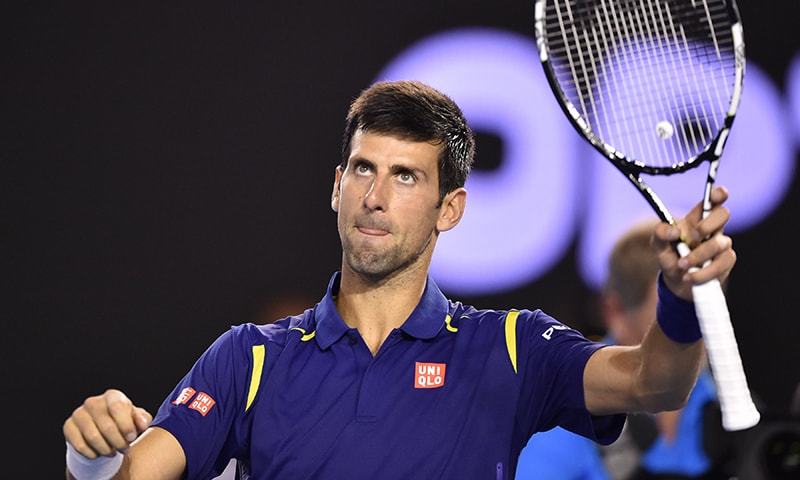
Match-fixing allegations: Djokovic wins, faces questions over 2007 loss

“I said everything I needed to say two days ago. Until somebody comes out with the real proof and evidence, it's only a speculation for me.” — AFP


MELBOURNE: For the second time in three days, Novak Djokovic won a match at the Australian Open and was confronted by questions about match-fixing in the sport.

The five-time champion had just beaten 19-year-old French wild-card entry Quentin Halys 6-1, 6-2, 7-6 (3) in the second round on Wednesday night – his 34th win in his last 35 matches at Melbourne Park – when his news conference veered to questions about the issue that has overshadowed the start of the season’s first major.

After his first-round win, on the day when the BBC and BuzzFeed News published reports alleging match-fixing had gone unchecked in tennis, the No. 1-ranked Djokovic recalled when a member of his support team was approached with an offer to throw a match in Russia in 2007.

That approach didn’t reach him directly, he said, and was rejected immediately.

After his second-round win, he was asked about an Italian newspaper report casting doubt over his performance in a match against Fabrice Santoro in Paris in 2007.

Djokovic said the speculation was getting out of control.

“What (is there) to say? I’ve lost that match. I don’t know if you’re trying to create a story about that match or for that matter any of the matches of the top players losing in the early rounds. I think it’s just absurd,” Djokovic said.

“It’s not true.

“My response is that there’s always going to be, especially these days when there is a lot of speculation – this is now the main story in tennis, in sports world – there’s going to be a lot of allegations,” Djokovic said.

“I said everything I needed to say two days ago. Until somebody comes out with the real proof and evidence, it’s only a speculation for me.”

Djokovic lost to Santoro 6-3, 6-2 in the second round of the Paris Masters indoor tournament in October 2007. Djokovic, who had two wisdom teeth removed after the Madrid Masters earlier that month, said after the loss to Santoro that he was not fully fit because he was still taking medication.

The BBC and BuzzFeed reports said 16 players had been repeatedly flagged to tennis authorities for suspicious performances, including a Grand Slam winner, and half of them were at this year’s Australian Open.

Djokovic has said he didn’t believe any elite players were involved. Roger Federer agreed, and said people making the accusations should name names.

Top seeds progress

On Wednesday, Federer extended his streak of reaching the third round at the Australian Open to 17 consecutive years. The four-time Australian Open champion, playing his 65th consecutive major, advanced 6-3, 7-5, 6-1 over Alexandr Dolgopolov. It was Federer’s 299th match win at a major.

He lost in the third round in his first two trips to Melbourne Park in 2000 and ’01 and again last year – in between he won the title four times and lost one final during a run of reaching the semifinals or better in 11 straight years.

“It’s the least I expect to be in the third round of a Slam, obviously, so I’m pumped up, playing well, feeling good,” Federer said.

“But there’s always a danger, you know. Like last year the third round was the end for me, so I hope to go further this time.”

Federer will next play Grigor Dimitrov, who beat Marco Trungelliti 6-3, 4-6, 6-2, 7-5.

Jo-Wilfried Tsonga went to the aid of a ball girl in his match, gently helping her off the court in the third set when she became ill before finishing off a 7-5, 6-1, 6-4 win over Omar Jasika.

Other seeded players advancing included No. 6 Tomas Berdych, No. 7 Kei Nishikori and 2014 US Open champion Marin Cilic.

Serena Williams set a record when she played her 79th main draw match at the Australian Open, and beat No. 90-ranked Hsieh Su-wei 6-1, 6-2.

“It all started here. This is where I played my first Grand Slam right on this court and I’m still going, it’s such an honor,” said Williams, a six-time champion who has a 70-9 record at Melbourne Park. “I love it every time I come here.”

In the biggest upset of the day, two-time Wimbledon champion and sixth-seeded Petra Kvitova was beaten 6-4, 6-4 by Russian-born Australian Daria Gavrilova.

Williams’ next opponent will be 18-year-old Russian Daria Kasatkina, who beat Croatia’s Ana Konjuh 6-4, 6-3, and she faces a potential quarterfinal match against 2015 finalist Maria Sharapova, who reached the third round with a 6-2, 6-1 win over Aliaksandra Sasnovich.

No. 13 Roberta Vinci beat Irina Falconi 6-2, 6-3 to advance, and is a potential fourth-round rival for No. 4 Agnieszka Radwanska, who beat Eugenie Bouchard 6-4, 6-2 in a match featuring two former Wimbledon finalists.

Breakthroughs made in identifying Bacha Khan University attackers: DG ISPR

Lt Gen Asim Bajwa says terrorists' phone calls have been traced and analysed; two cell phones recovered.


PESHAWAR: Inter-Services Public Relations (ISPR) Director General Lt Gen Asim Bajwa on Wednesday said major breakthroughs had been made in identifying the terrorists who attack the bacha khan university in Charsadda earlier in the day.

The ISPR chief said the terrorists’ phone calls had been traced and analysed, and that two cell phones had also been recovered from them.

“Their call logs were analysed and an intelligence picture was established, with most data having been collected,” said Lt Gen Bajwa.

4 killed in suicide blast near Russian embassy in Kabul

kabul-blast-20-jan-16


KABUL (Web Desk) – An explosion took place outside the Russian Embassy in Afghanistan’s capital, Kabul on Wednesday.

According to TOLOnews a motor cycle bomber detonated his explosives targeting a civilian bus Dar-ul-Aman road in Kabul where at least four dead and 24 injured in the explosion.


According to reports the Russian embassy staff not injured.

Schools shut down in six states of USA over threats

school1


LOS ANGELES (Web Desk) — Dozens of schools were evacuated in six states of the USA on Tuesday after callers or emails threatened to shoot or bomb students and staff.

Threats came to individual schools in Delaware, Iowa, Maryland, Massachusetts, New Jersey and Pennsylvania and were the latest in weeks of threats affecting schools in the United States, UPI reported.

No credible threats have been found, but the steady flow of disruption and alarm has cost school districts time and money, and stirred anxiety about possible terrorist attacks.

The problem might has started in December when Los Angeles Unified School District, the second largest in the country, was forced to close all of its more than 900 schools after a threatening email.

Threats have often come in the form of a computer-generated robocall, officials told NBC. Some of which were routed through Bakersfield, California.

The technology mostly used by telemarketers and political campaigns is easily accessible through websites that offer the services for less than a penny a minute.

Police in New Jersey said they were taking “all precautions” to “ensure safety” and closed various schools before taking bomb-sniffing dogs through campuses, even though they did not believe the threat was real.

Police and school staff in Massachusetts faced the same challenges.

PM Nawaz announces national mourning on Thursday over university attack

Nawaz_Sharif1


ISLAMABAD (Staff Reporter) – Prime Minister Nawaz Sharif on Wednesday announced to observe a day of national mourning across the country on Thursday following the deadly terrorist attack on the Bacha Khan University in Charsadda.

Prime Minister Sharif, who is in Davos to attend the World Economic Forum (WEF), also telephoned Army Chief General Raheel Sharif and appreciated the swift military action after the terrorist assault.

Meanwhile, the Khyber Pakhunkhwa government also announced 3-day of mourning across the province.

At least 30 people mostly students embraced martyrdom and scores of others were wounded when four heavily-armed gunmen stormed Bacha Khan University on Wednesday morning.

Oil dives to fresh 12-year low under $28

oil


LONDON (APP) – Oil plunged to fresh 12-year lows under $28 on Wednesday, slammed by gloomy economic forecasts, China’s slowdown and abundant crude supplies.

In morning deals, US benchmark West Texas Intermediate (WTI) for February delivery tanked to $27.32 per barrel, a level last seen on September 24, 2003.

The contract later stood at $27.80, down 66 cents from Tuesday’s closing level.

The global oil market has collapsed further since the International Energy Agency warned Tuesday that the oil market could “drown in oversupply”. Prices have crashed about 75 percent since mid-2014, hit by a perfect storm of a stubborn supply glut, the slowing global economy and the rebounding US dollar.

“A stronger dollar continues to present significant headwinds and supply increases show little sign of letting up any time soon,” Sucden analyst Kash Kamal told AFP. “This is very much a supply issue, as global demand has on the whole been quite healthy — but it is likely we will see additional price declines and tighter margins before producers are prompted to cut output.”

The strong dollar meanwhile makes dollar-priced crude more expensive for buyers using weaker currencies. In turn, that dents demand and prices.

Approaching midday in London, Brent North Sea crude for delivery in March slid 67 cents to $28.09 compared with the close on Tuesday.

Brent had tumbled on Tuesday to $27.67, a low last witnessed on November 25, 2003.

Crude futures are also in freefall with the supply glut set to worsen, as Iran pumps out extra barrels after the lifting of Western sanctions on Tehran.

The IEA predicted Tuesday that prices would fall further this year as supply vastly exceeds demand, with major oil exporter Iran’s return to the market offsetting any production cuts from other countries.

Match-fixing and tech: Betting apps fueling corruption in sports

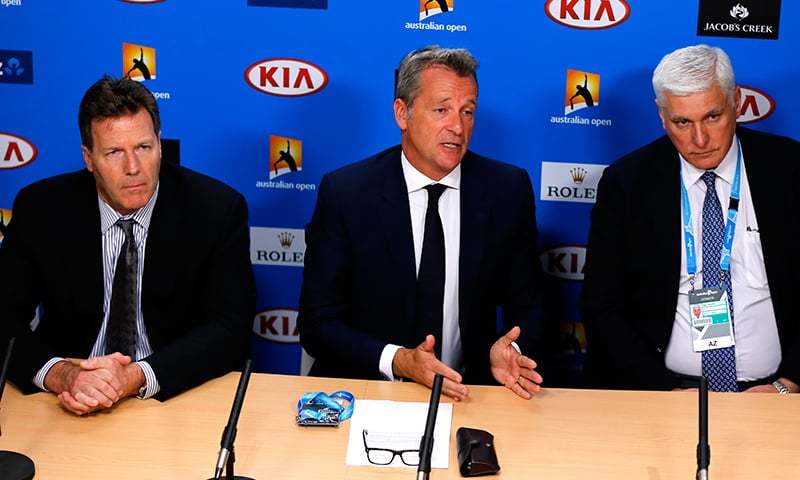
ATP Chairman Kermode and the Tennis Integrity United have rejected news reports that match-fixing has gone unchecked in the sport. — AP/File


SYDNEY: The rise of mobile betting is transforming global sports wagering faster than regulators can react, flooding the industry with cash and potentially contributing to corruption scandals like the one roiling world tennis, experts and insiders say.

Allegations this week that tennis authorities failed to deal with widespread match-fixing has rocked the game, following similar allegations that have blighted cricket, football and other sports.

The ubiquity of mobile phones and tablets has helped transformed bookmakers from operators of dingy, smoke-filled betting shops into multi-billion dollar de facto tech firms, pouring resources into developing apps and complex algorithms and marketing to younger and broader demographics.

“We’re no longer restricted by geography or the limited choices of one betting company. And we have wall-to-wall sport every day of the week from across the globe beamed into our lounge rooms, on our smartphones,” said Scott Ferguson, a wagering industry consultant.

“Technology is everything.”

The greatest danger for mobile gambling to intersect with corruption lies in the ease of fixing a one-on-one sport like tennis, darts or snooker, according to experts and professional gamblers.

Mobile apps that allow in-game betting on individual points or games allow athletes to stealthily manipulate the results and may strike some of them as less unethical as throwing an entire match, said Sally Gainsbury, a senior lecturer at Southern Cross University who has written a book on the subject.

“A Perfect Combination”

Most major bookmakers operate from small offshore jurisdictions, making accurate predictions of industry worth extremely difficult, said Gainsbury.

“There’s a large grey sort of offshore market … in every country, where it’s actually just not possible for the government to regulate these sites that are based in all these tiny remote jurisdictions,” she told Reuters.

“So it’s difficult to get a really accurate size of how much people are betting because a lot of it is actually illegal.”

Patrick Jay, a betting consultant and former head of trading at Betfair, estimates the global sports betting market is likely worth about $1 trillion a year, having doubled in size in the last five years. He expects it to double again in the next five.

The Australian government, citing a 2015 United Nations conference at which Jay was a speaker, put that figure as high as $3 trillion, of which 90 percent was “illegal” or in contravention of laws regulating gambling in which the bet was placed.

That range of figures, which includes betting on sports from soccer, cricket and tennis to much less widely followed sports like snooker, darts and table tennis but excludes racing, illustrates the difficulty in accurately valuing the overall market.

“It has grown because of mobile technology. It allows people to place bets anywhere, anytime,” Jay told Reuters. “People are also dealing in credit, and therefore accounts are being run all over the world. It has created a perfect combination.”

Leading bookmakers including Betfair Group PLC, Ladbrokes PLC, Paddy Power PLC and William Hill PLC did not respond to requests for comment. There have not been any allegations of wrongdoing by the bookmakers in the World Tennis scandal.

Worried about the boom in sports betting and incidents of match fixing, countries like Australia and across the European Union are in the process of reviewing laws that experts like Gainsbury say are “hopelessly outdated”.

In Australia, for example, 2001 laws regulating Internet sport betting bar anyone from placing a bet on a sporting event online once it has begun, despite allowing live betting over the phone or at retail bookmakers.

William Hill, an official partner of the Australian Open, has a new “Bet-in-Play” feature for its Australian customers that requires access to a smartphone’s microphone while the bet is placed to comply with such laws.

“There’s been a lot of stagnation where a lot of countries originally said, ‘Well this is illegal, we won’t let them do this’, but of course with the internet you can’t make things illegal and stop people going online,” Gainsbury said.